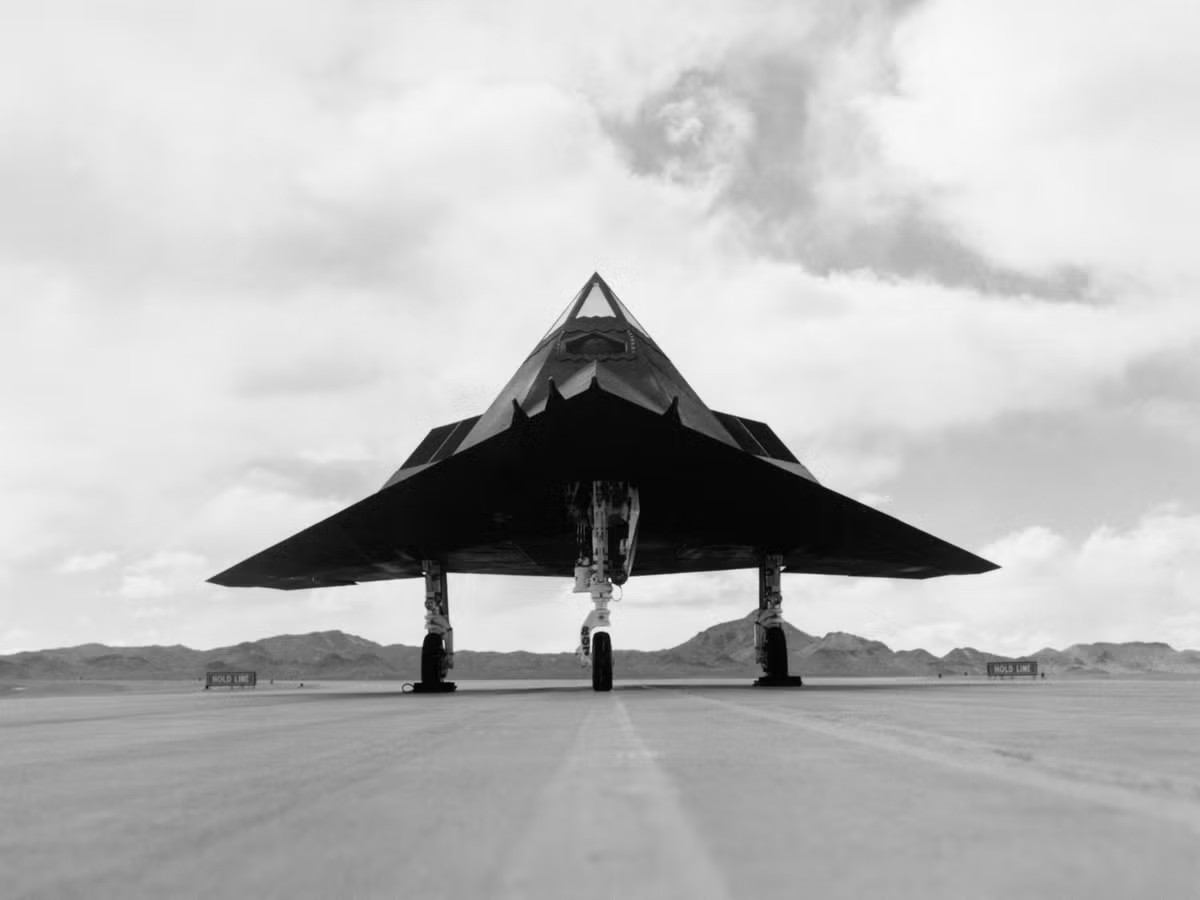
Few aircraft in modern military history have captured public imagination quite like the F-117 Nighthawk. Born from a secretive Cold War program, this angular, black-painted jet became the world’s first operational aircraft built specifically around stealth technology. Its unusual faceted shape, once dismissed by casual observers as science fiction, proved that radar evasion could be achieved through geometry rather than raw speed or brute firepower. For decades, the very existence of such a machine was hidden from the public, adding an air of mystery that still surrounds it today.
Developed by Lockheed’s famed Skunk Works division, the F-117 Nighthawk emerged from a need to penetrate heavily defended airspace without being detected. Unlike traditional fighters that relied on speed or maneuverability to survive, this aircraft was designed to simply avoid being seen by enemy radar systems altogether. That single design philosophy transformed how air forces around the world thought about combat aircraft, ushering in an entirely new category of military technology that continues to influence aircraft design to this day.
Origins in Secrecy: How the Program Began
The story of the F-117 Nighthawk begins in the 1970s, when American engineers discovered that flat panels arranged at specific angles could scatter radar waves away from their source rather than reflecting them back. This breakthrough, rooted partly in mathematical research originally published by a Soviet physicist, gave Lockheed engineers the foundation they needed to build a genuinely stealthy airframe. The resulting aircraft looked nothing like conventional jets of the era, favoring sharp, faceted surfaces over smooth aerodynamic curves.
Development proceeded under intense secrecy at a remote test facility in Nevada. Engineers nicknamed the early prototype “Have Blue,” and after successful testing, the program evolved into what would become the operational F-117 Nighthawk. Its first flight occurred in 1981, though the public would not learn of the aircraft’s existence for several more years. The Air Force maintained strict operational security, flying missions only at night and keeping the program classified well into the late 1980s.
Design Philosophy: Stealth Through Angles
What truly sets the F-117 Nighthawk apart from other fighters is its unconventional silhouette. Rather than smooth, rounded surfaces typical of high-performance aircraft, engineers gave it a faceted body composed of flat panels meeting at sharp angles. This design deflects incoming radar waves in directions away from the receiving station, making the aircraft appear far smaller on radar screens than its actual physical size would suggest.
Several key features contributed to this radar-evading capability:
- A faceted airframe built from flat composite panels instead of curved metal skin
- Radar-absorbent coatings applied across the exterior surface
- Engine exhausts shaped to reduce infrared and radar signatures
- Internally carried weapons to avoid external radar reflections
- No radar system onboard, relying instead on infrared targeting to remain undetected
These design choices came with trade-offs. The aircraft was aerodynamically unstable without computer-assisted flight controls, earning it the nickname “Wobblin’ Goblin” among early pilots. Despite this quirky handling reputation, the F-117 Nighthawk proved remarkably effective at its intended mission of penetrating contested airspace undetected.
Performance and Technical Specifications
Unlike traditional fighter jets built for speed and dogfighting, the F-117 Nighthawk was never intended to outmaneuver enemy aircraft. It was a subsonic attack platform designed purely for precision strikes against high-value targets while remaining invisible to radar. Its twin engines produced modest thrust compared to supersonic fighters, but that was never the point of its design.
| Specification | Detail |
|---|---|
| Manufacturer | Lockheed Skunk Works |
| First Flight | 1981 |
| Operational Service | 1983 to 2008 |
| Crew | Single pilot |
| Top Speed | Subsonic, approximately 623 mph |
| Engines | Two General Electric F404 turbofans |
| Length | Roughly 65 feet |
| Wingspan | Roughly 43 feet |
| Primary Role | Precision ground attack and reconnaissance |
| Weapons | Internally carried, typically laser-guided bombs |
This table highlights just how different the F-117 Nighthawk was from contemporaries built for speed and agility. Its value came entirely from being unseen, not from outrunning or outfighting adversaries in the traditional sense.
Combat Debut and Early Missions
The first real test of the F-117 Nighthawk in combat came during the 1989 invasion of Panama, where it conducted limited strikes to demonstrate its capabilities. However, it was the Gulf War in 1991 that truly proved the aircraft’s worth on a global stage. Flying missions over heavily defended Iraqi airspace, these stealth jets struck critical command centers, communication hubs, and air defense installations with remarkable precision.

During that conflict, the F-117 Nighthawk flew a small percentage of total combat sorties yet was credited with striking a disproportionately large share of the most heavily defended targets. Pilots operated almost exclusively under cover of darkness, slipping past radar networks that had been built specifically to detect incoming aircraft. The success of these missions validated years of secretive development and cemented stealth technology as a permanent fixture in modern air warfare doctrine.
The Kosovo Incident: A Rare Setback
Despite its impressive combat record, the F-117 Nighthawk was not invincible. In 1999, during operations over the former Yugoslavia, one aircraft was shot down by Serbian forces using older Soviet-era surface-to-air missile technology combined with clever tactical adaptations. This event became one of the most studied incidents in modern military aviation history, demonstrating that even advanced stealth aircraft required careful operational planning to maintain their advantage.
The pilot ejected safely and was rescued, but the incident revealed important lessons about predictable flight patterns and the limitations of stealth against determined, resourceful defenders. Rather than diminishing the aircraft’s reputation, this event prompted deeper analysis of how stealth technology should be integrated with broader tactical planning, electronic warfare support, and mission timing. It served as a reminder that no technology, however advanced, eliminates every vulnerability entirely.
Retirement and Lasting Legacy
By the mid-2000s, newer stealth platforms had begun to surpass the aging design of the F-117 Nighthawk. Aircraft like the F-22 Raptor offered stealth combined with supersonic speed and advanced sensor fusion, capabilities the older airframe simply could not match. The Air Force officially retired the fleet in 2008, moving many aircraft into storage at a desert facility rather than scrapping them entirely.
Interestingly, retirement did not mean the end of the story. Observers have reported occasional sightings of these aircraft flying test missions over the years since their official retirement, suggesting they continue to serve limited roles in training or evaluation programs. This unusual afterlife has only added to the mystique surrounding the aircraft, keeping public curiosity alive long after its front-line service ended.
The influence of the F-117 Nighthawk extends far beyond its own operational lifespan. It proved that stealth was not merely theoretical but a practical, achievable goal for military aviation. Every subsequent stealth aircraft, from bombers to fighters, owes a conceptual debt to the pioneering work done during this aircraft’s development. Engineers and military planners worldwide studied its successes and shortcomings to refine future designs.
Why the F-117 Nighthawk Still Matters Today
Even though it no longer flies combat missions, the F-117 Nighthawk remains a touchstone in discussions about military technology and innovation. It represents a moment when engineering ingenuity solved a problem many considered nearly impossible, using mathematics and materials science rather than raw power. Museums, documentaries, and aviation enthusiasts continue to celebrate its unusual shape and groundbreaking role in shaping modern air combat strategy.
Its legacy also serves as a case study in balancing innovation with practical limitations. The aircraft’s unstable flight characteristics, reliance on darkness for safety, and eventual vulnerability in Kosovo all offer valuable lessons for engineers designing future stealth platforms. Understanding both the triumphs and shortcomings of this program provides a fuller picture of how military aviation technology evolves over time, often through trial, error, and hard-won experience gained under real combat conditions.
Conclusion
The F-117 Nighthawk stands as one of the most consequential aircraft in modern military history, not because of its speed or firepower, but because of the revolutionary idea it embodied. By proving that an aircraft could be engineered to virtually disappear from radar, it opened the door to an entirely new era of aerial warfare. From its secretive origins in the Nevada desert to its decisive role in the Gulf War and its sobering lesson over Kosovo, this unusual angular jet left an indelible mark on aviation history. Decades after its retirement, the F-117 Nighthawk continues to be studied, admired, and remembered as the aircraft that first showed the world stealth was not science fiction, but a genuine tool of modern warfare.
Leave a Reply