
The story of Indian fighter jets is really the story of a nation trying to balance urgency with self-reliance. For decades, the Indian Air Force has operated a mixed fleet drawn from Russian, French, and domestic sources, and that pattern continues today. The Su-30MKI still forms the numerical core of the fleet, with roughly 260 aircraft in service, while newer additions like the Rafale bring in advanced multirole capability. What makes this moment different is the scale of change underway. Squadron strength has slipped to around 29 to 31, well below the sanctioned target of 42, and that gap has pushed planners to accelerate acquisition and indigenous production simultaneously rather than choosing one path over the other.
This dual approach reflects a hard lesson learned over the years: relying purely on imports leaves the country exposed to supply delays, while relying purely on domestic development risks falling behind evolving regional threats.
Tejas: The Homegrown Light Combat Aircraft
No conversation about Indian fighter jets is complete without the Tejas, HAL’s indigenous light combat aircraft. It was conceived to replace the ageing MiG-21 fleet and has slowly matured into a credible platform, even as its journey has been marked by delays, particularly around engine supply. The Tejas Mk1A variant, ordered in numbers exceeding 180 aircraft, is expected to move into volume deliveries later this year, giving the air force a steady stream of new jets at a fraction of the cost of imported alternatives.
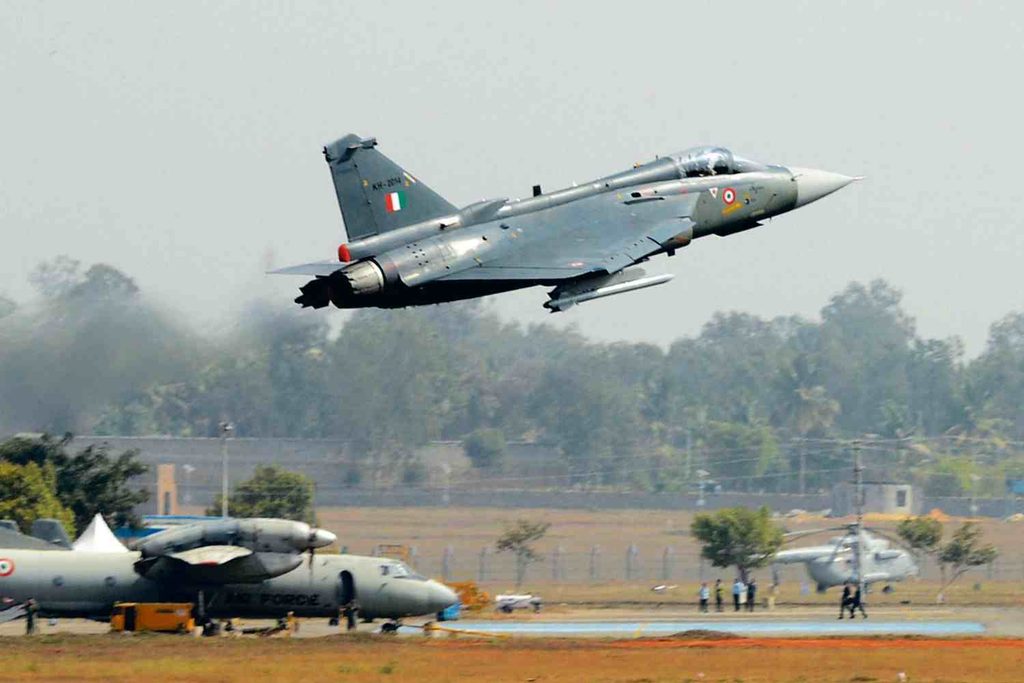
Beyond the Mk1A, HAL is developing the Tejas Mk2, a heavier and more powerful single-engine fighter intended to eventually replace the Mirage 2000, Jaguar, and MiG-29 fleets. It will use the GE F414 engine and carry a larger payload, though its first test flight is not expected before 2027. Some senior officers have already cautioned that the Mk2 alone may not be sufficient for the most demanding frontline missions, which is one reason the Rafale continues to occupy such a central place in planning.
Rafale: Filling the Capability Gap
The Dassault Rafale has become the most talked-about addition among modern Indian fighter jets, prized for its versatility across air superiority, strike, and reconnaissance roles. Thirty-six Rafales already serve with the air force, and in early 2026 the Defence Acquisition Council cleared a long-pending proposal to procure 114 more aircraft under the Multi-Role Fighter Aircraft programme, at a cost estimated near four trillion rupees. Of these, a portion will arrive as fly-away units while the majority will be assembled domestically, continuing the shift toward local manufacturing partnerships.
This expanded Rafale order matters because it buys time. With Tejas Mk1A deliveries running behind schedule and the Mk2 still years from operational service, the Rafale offers immediate, proven capability while indigenous programmes catch up. The Navy is also inducting a maritime variant, the Rafale M, further tightening the aircraft’s role across services.
Su-30MKI and the Super Sukhoi Upgrade
While newer platforms attract headlines, the Su-30MKI remains the workhorse among Indian fighter jets, and retiring 260 aircraft all at once was never realistic. Instead, the air force has committed to a large-scale upgrade programme, often referred to informally as the “Super Sukhoi” effort. This includes fitting the fleet with an India-developed AESA radar, modernized avionics, and improved weapons integration, extending the aircraft’s relevance well into the next decade.
This approach illustrates a broader principle guiding India’s air power strategy: modernization does not always mean replacement. Upgrading an existing, well-understood platform can deliver meaningful capability gains without the risk and cost of a completely new acquisition, while keeping squadrons operational throughout the transition.
AMCA: The Fifth-Generation Ambition
Looking further ahead, the Advanced Medium Combat Aircraft represents India’s most ambitious step among Indian fighter jets programmes. Designed as a domestically developed fifth-generation stealth fighter, the AMCA is intended to eventually anchor the air force’s high-end combat capability. Development timelines have shifted repeatedly over the years, and current projections place meaningful operational induction sometime in the mid-to-late 2030s, considerably later than early estimates once suggested.
The programme’s importance goes beyond raw capability. A successful AMCA would mark India’s entry into a small club of nations capable of designing and building stealth fighters independently, reducing long-term dependence on foreign suppliers for the most advanced tier of air combat technology.
A Quick Comparison of Key Platforms
| Aircraft | Origin | Generation | Current Status |
|---|---|---|---|
| Su-30MKI | Russia/India | 4th | In service, undergoing AESA radar upgrade |
| Tejas Mk1A | India | 4.5th | Entering volume deliveries |
| Tejas Mk2 | India | 4.5th | First flight expected around 2027 |
| Rafale | France | 4.5th | 36 in service; 114 more ordered |
| AMCA | India | 5th | In development, induction expected mid-to-late 2030s |
Why the Pace of Induction Matters
Squadron numbers alone do not tell the full story, but they remain a useful benchmark. Air force leadership has floated an ambitious target of inducting around 40 jets annually once Rafale and Tejas Mk2 production lines run in parallel with steady Tejas Mk1A output. Achieving that would require:
- Consistent engine supply for Tejas variants, historically a bottleneck
- Timely execution of the 114-aircraft Rafale order through domestic assembly
- Avoiding “production valleys,” the gaps between one aircraft’s phase-out and another’s ramp-up
- Parallel investment in trainers, simulators, and maintenance infrastructure to support a growing fleet
None of this is guaranteed, and industry watchers note that ambitious targets have slipped before. Still, the combination of a cleared Rafale order, maturing Tejas production, and a funded upgrade path for the Su-30MKI represents a more coordinated push than India’s air force has managed in previous decades.
Balancing Cost, Capability, and Timelines
Every choice among Indian fighter jets involves trade-offs. The Tejas is affordable and boosts domestic industry but arrives with capability limitations compared to heavier platforms. The Rafale is combat-proven and versatile but expensive, and scaling up its numbers takes years even with local assembly. The Su-30MKI upgrade extends the life of an already large fleet but cannot fully substitute for newer technology. The AMCA promises the biggest long-term payoff but carries the most schedule risk.
Recognizing these trade-offs, planners appear to be leaning on a layered strategy rather than betting everything on one aircraft. Older platforms get upgraded rather than retired outright, mid-tier capability is filled by Tejas variants, and top-tier missions lean on the Rafale until the Mk2 and eventually the AMCA mature.
Conclusion
The current chapter in the evolution of Indian fighter jets is defined less by any single aircraft and more by how multiple programmes are being woven together. The Su-30MKI is being modernized rather than shelved, the Tejas family is scaling toward volume production despite past delays, the Rafale fleet is expanding to bridge the capability gap, and the AMCA sits on the horizon as the long-term stealth ambition. Squadron numbers remain below target, and timelines for newer platforms continue to shift, so patience and consistent execution will matter as much as any single procurement decision. What is clear is that India is no longer choosing between imported strength and indigenous development; it is pursuing both at once, betting that a diversified, layered fleet will deliver the resilience its air force needs for the decades ahead.
Leave a Reply