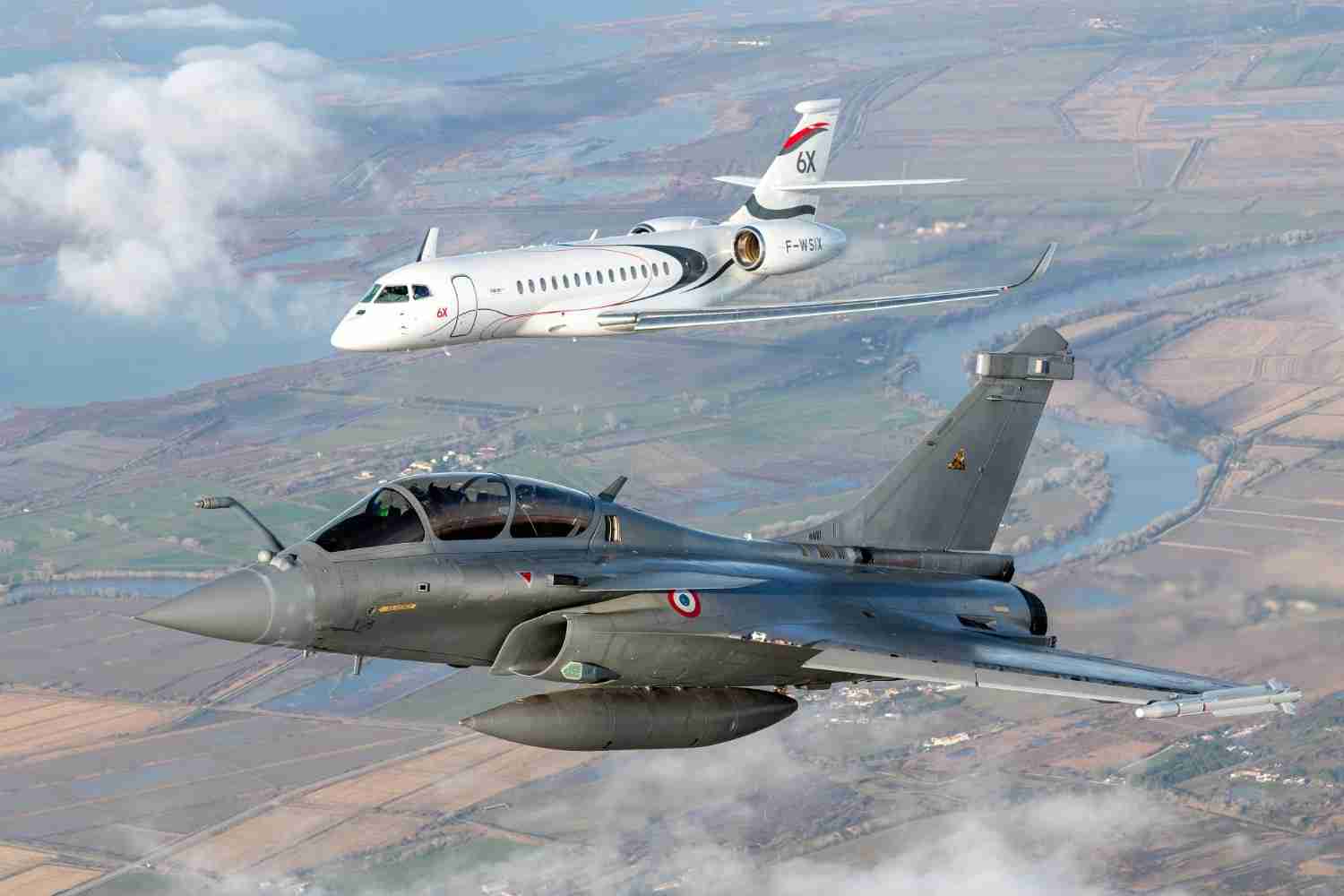
France’s defense establishment is entering a defining decade for military aviation, and at the center of it sits the Rafale F5. What began years ago as a routine upgrade cycle for Dassault Aviation’s flagship fighter has evolved into something far more ambitious. Officials now describe the Rafale F5 not as a minor refresh but as a near-total transformation of the aircraft’s capabilities, positioning it to remain relevant well into the 2040s. With the collapse of parts of the joint Franco-German-Spanish Future Combat Air System program, France has doubled down on the Rafale F5 as its bridge to next-generation air power, backing it with billions of euros in fresh funding and a clear production timeline.
What Makes the Rafale F5 Different
Unlike previous incremental updates such as the F3 or F4 standards, the Rafale F5 represents a genuine leap forward. Industry insiders and defense analysts increasingly refer to it as a “Super Rafale” because the scope of changes touches nearly every subsystem of the airframe. The Rafale F5 will introduce a reinforced computing architecture, a new radar system, upgraded electronic warfare suites, and significantly improved connectivity for networked combat operations. Perhaps most notably, the Rafale F5 is being designed from the outset to operate alongside stealthy unmanned “loyal wingman” drones, giving French pilots a manned-unmanned teaming capability that didn’t exist in earlier Rafale generations. This shift changes how the jet fits into France’s broader airpower doctrine.
New Engine and Airframe Improvements
A central pillar of the Rafale F5 program is propulsion. France is developing a domestically produced, high-thrust engine internally referred to as T-REX, intended to give the aircraft greater power, range, and payload capacity than the current M88 engines allow. Alongside this, the Rafale F5 will receive an extended airframe life package, ensuring the jets can remain operationally viable for decades beyond their original service projections. Engineers are also integrating a next-generation inertial navigation system built around a hemispherical resonator gyroscope, prized for its extremely low drift rate. These structural and propulsion upgrades aren’t cosmetic; they fundamentally change how far, how fast, and how long a Rafale F5 can operate in contested airspace.
Weapons and Nuclear Deterrence Role
The Rafale F5 is deeply tied to France’s nuclear deterrence strategy. It has been designated as a launch platform for the ASN4G, a fourth-generation nuclear-armed hypersonic cruise missile currently under development by MBDA, with entry into service targeted around 2035. Beyond nuclear capability, the Rafale F5 is expected to carry the STRATUS RS missile for suppression of enemy air defenses and anti-ship missions, along with the MICA-NG air-to-air missile, which has already completed supersonic-configuration test firings. This combination of conventional strike power and strategic deterrence makes the Rafale F5 arguably the most consequential French combat aircraft program since the original Rafale entered service.
Connectivity and the Inter-Vehicle Data Link
Modern warfare increasingly depends on data sharing across platforms, and the Rafale F5 has been engineered with this priority front and center. Thales has been contracted to develop a new Inter-Vehicle Data Link, a stealthy and resilient communication system allowing the Rafale F5 to exchange information securely with other aircraft, drones, and command nodes in real time. This capability supports what French officials call “collaborative combat” and the ability to “enter first” into contested environments, meaning the Rafale F5 can operate as a forward node that shares targeting data before other assets arrive. Combined with the CONTACT software-defined radio inherited from the F4 standard, this data architecture turns the Rafale F5 into a genuine networked warfighting system rather than a standalone jet.
Loyal Wingman Drones and Manned-Unmanned Teaming
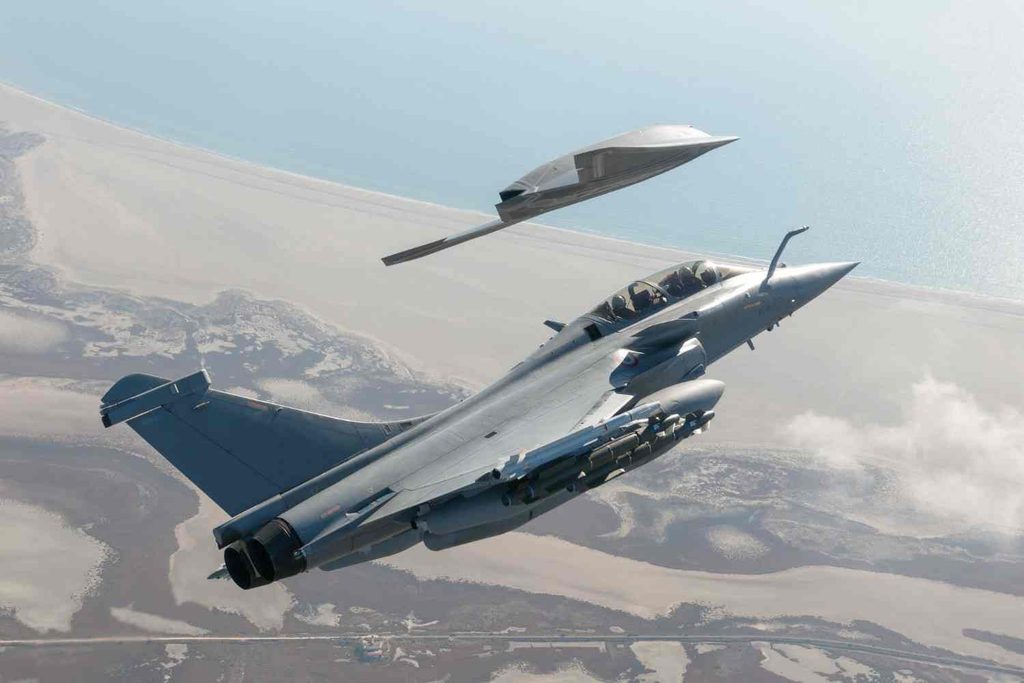
One of the most striking aspects of the Rafale F5 program is its pairing with an unmanned combat aerial vehicle, often compared to the nEUROn technology demonstrator. Dassault has already received a first development contract for this stealth companion drone, which is expected to fly alongside crewed Rafale F5 jets by around 2035. This manned-unmanned teaming concept allows a single pilot to control or coordinate with an armed drone, extending sensor reach and strike options while reducing risk to aircrew. France views this pairing as essential groundwork for eventually transitioning toward more autonomous combat systems, without abandoning the proven, adaptable Rafale platform in the process.
Timeline and Production Schedule
The Rafale F5 program has moved from conceptual planning into formal development. France’s updated military programming law, covering the 2024-2030 period, added roughly 36 billion euros in defense spending, with a significant portion earmarked specifically to launch the Rafale F5 standard. Below is a summary of key program milestones:
| Milestone | Timeline |
|---|---|
| Formal development launch | Late 2026 |
| First contracts to Dassault, Thales, MBDA, Safran | 2026 |
| Qualification of F5 standard | Around 2033 |
| Entry into service (Air and Space Force) | 2033–2035 |
| Export availability | From 2035 |
| Rafale F5 jets in French fleet | At least 47 by 2035 |
Twenty Rafale jets originally scheduled for delivery in 2031-2032 have been deliberately deferred to 2033-2034 so they can be built directly to the Rafale F5 standard rather than requiring retrofits later.
Industry Backing and Export Outlook
Dassault Aviation enters this phase from a position of commercial strength. The company closed out the prior year with a firm order backlog exceeding 200 aircraft, split between French orders and a substantial number of export customers. That financial and industrial momentum gives confidence that the Rafale F5 program will stay funded and on schedule domestically, even though export customers will need to wait until the mid-2030s before the F5 configuration becomes available to them. In the meantime, foreign buyers will continue receiving F4-standard jets, while France channels the most advanced Rafale F5 capabilities toward its own air force and navy first, reflecting the strategic priority Paris places on this next-generation upgrade.
Debate Within the French Military
Not everyone in France’s defense establishment is fully aligned on timing. Senior French Air Force leadership has voiced a preference for acquiring more F4-standard jets in the near term rather than waiting years for the Rafale F5 to mature, citing an increasingly volatile European security environment. This internal debate, aired during closed-door Senate hearings, underscores a genuine tension between fielding proven capability quickly versus investing patiently in the more transformative Rafale F5. Both paths carry trade-offs, and France’s ultimate approach will likely involve parallel tracks: sustaining F4 production for near-term fleet strength while methodically advancing the Rafale F5 toward its 2033 qualification target.
Why the Rafale F5 Matters Strategically
With the manned fighter component of the joint Franco-German-Spanish future combat system effectively shelved, the Rafale F5 has become France’s primary vehicle for maintaining air combat superiority through the 2040s. It’s no longer simply an upgrade path for an aircraft designed in the 1980s; French planners now frame the Rafale F5 as a genuine fifth-generation-adjacent capability, bridging the gap until any future sixth-generation platform materializes. This repositioning reflects lessons learned from recent conflicts, where survivability, sensor fusion, and networked operations have proven decisive. The Rafale F5, in this sense, isn’t just a technical upgrade — it’s a strategic hedge against an uncertain future for European combat aviation cooperation.
Conclusion
The Rafale F5 marks a pivotal moment for French military aviation, transforming a decades-old airframe into a networked, drone-paired, nuclear-capable platform built for the challenges of the 2030s and beyond. From its new T-REX engine and reinforced computing core to its stealthy data links and loyal wingman drones, the Rafale F5 represents far more than an incremental step. It reflects France’s determination to secure sovereign airpower amid shifting alliances and stalled multinational programs. Whether viewed as a mid-life renovation or a near-new aircraft, the Rafale F5 will define French combat aviation for the next generation, and its progress over the coming years will be closely watched by allies and export customers alike.
Leave a Reply